Comparing Specialty Cleaning Bids: Why Price Alone Doesn’t Tell the Story
When you manage a commercial building, condominium, HOA or other large property, there are plenty of reasons to compare bids before approving a cleaning project. Budgets matter, and nobody wants to pay more than necessary for carpet cleaning, floor care, pressure washing or another specialty service.
But what happens when one bid comes in dramatically lower than the others?
We recently had a longtime customer face exactly that decision.
Clean Advantage had handled the property’s carpet cleaning the previous year, and the customer was very happy with the results. When it was time to clean the carpets again, they asked us for another proposal.
There was just one problem.
Another company had submitted a bid for roughly half the price.
The customer was upfront with us. They wanted to work with Clean Advantage, but they also had a responsibility to look at the numbers. Could we come down enough to compete?
We took another look at the project. The problem was that cutting our price in half would have meant changing the job itself.
Our proposal was based on the amount of labor we believed the property required, the equipment and cleaning products we planned to use, the condition of the carpeting and the time needed to complete the work properly. We could reduce the number of service hours. We could change the process. We could use less expensive products.
But then we would no longer be quoting the same service.
So we explained our reasoning and stood behind the proposal.
The customer decided to try the less expensive company.
Two days after that company began the work, our phone rang. The customer was unhappy with the results and wanted Clean Advantage to come back.
That call illustrated something property owners and executives should keep in mind whenever they compare specialty cleaning services. A lower bid is only a bargain when the scope and results are truly comparable.
Two Cleaning Proposals Can Describe Two Very Different Jobs
A proposal may say “carpet cleaning,” “floor care” or “pressure washing,” but that description alone tells you very little about how the work will actually be performed.
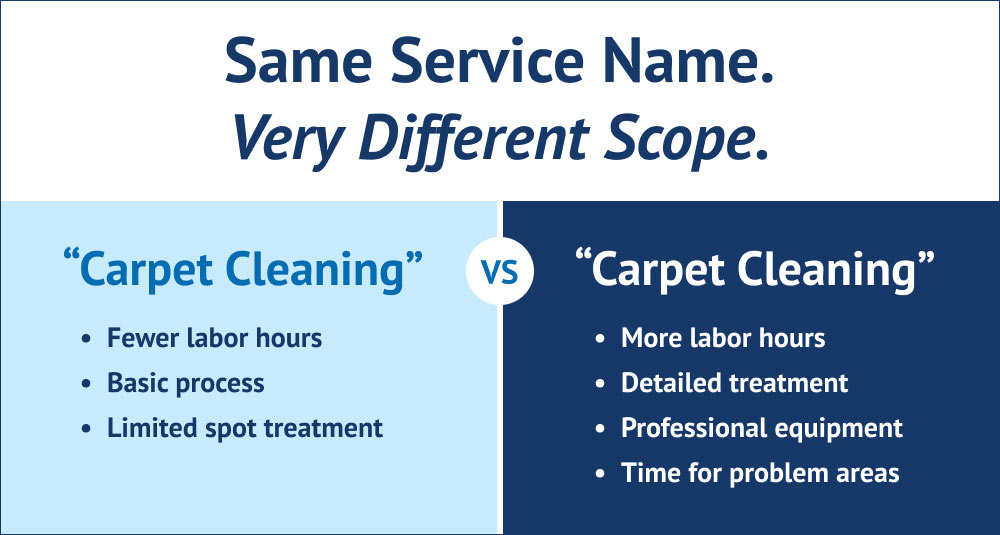
Consider carpet cleaning. One contractor may budget enough labor to thoroughly clean the entire area, treat heavily traveled or stained sections separately and use professional equipment and products appropriate for the carpet. Another contractor may be planning a faster process with fewer service hours.
Both proposals still say “carpet cleaning.”
The same issue comes up with hard-surface floor care, stripping and waxing, pressure washing and other project-based services. The labor hours, preparation, equipment, materials and process can vary considerably from one contractor to another.
Before comparing the totals at the bottom of the page, make sure you are comparing the work described above them.
Ask What Is Behind the Number
When there is a significant difference between bids, that difference deserves a conversation.
Ask how many labor hours are built into the proposal. Find out what equipment will be used and whether particular stains, high-traffic areas or problem spots require additional treatment. Ask about the cleaning products and processes being proposed and how much time the contractor expects the project to take.
These questions are not about choosing the most expensive proposal. They are about understanding why the numbers are different.
Sometimes a company really has found a more efficient way to perform the work. Better equipment, smarter scheduling or an experienced crew may allow a contractor to produce an excellent result efficiently.
In other cases, the lower price comes from simply doing less.
You cannot tell which situation you are looking at from the total price alone.
The Cost of a Cleaning Project Does Not End With the Invoice
For an owner, CEO or property management company, there is another cost that can be easy to overlook: the time your own team spends fixing a project that did not go well.
If carpets have to be cleaned again, floors have to be refinished, residents complain about the condition of common areas, or management has to chase a vendor to correct problems, the savings on the original proposal begin disappearing quickly.
There can also be a visible cost. Lobbies, hallways, carpets, floors and exterior common areas are part of the everyday experience of tenants, residents, employees and visitors. When a specialty cleaning project is done well, most people may never think twice about it. When it is done poorly, they notice.
That is why value should include more than the invoice. It should include the quality of the finished work and the amount of management time required to get there.

We Price the Work We Believe the Property Needs
At Clean Advantage, we know we will not be the lowest bidder on every specialty cleaning project.
Our goal is not to work backward from the lowest possible number. We look at the property, the condition of the area being cleaned and the result the customer expects, and then build the service around what we believe the job requires.
That does not mean customers should accept a higher bid without asking questions. In fact, we encourage them to ask. A cleaning company should be able to explain what is included, how the work will be performed and what is driving the price.
When you have that information, you can make a much better comparison.
If one specialty cleaning proposal comes in substantially below the others, don’t automatically dismiss it. But before you sign it, ask one more question:
What are they doing differently to make the price that much lower?
The answer may tell you more than the price itself.

Talk With Clean Advantage About Your Next Specialty Cleaning Project
Clean Advantage provides carpet and floor cleaning, pressure washing and other comprehensive cleaning services for commercial and residential properties throughout Maryland, Washington, D.C. and Northern Virginia.
If you are planning a cleaning project and want to understand what the work really requires, contact Clean Advantage. We can evaluate the property, discuss the scope and provide a proposal built around the job that needs to be done.