
Before You Sign a Janitorial Contract, Read the Cancellation Clause Carefully
When property managers review a janitorial proposal, most of the attention naturally goes to the scope of work, staffing, pricing and service expectations. How often will the building be cleaned? What is included? Who provides supplies? How are service problems handled? Those are all important questions, but there is another part of the agreement that can become just as important later and often receives much less attention at the beginning: the termination or cancellation clause.
It is easy to skim over that section when everything is going well and both parties are optimistic about the relationship. Six months or a year later, circumstances may be different. Service may no longer be meeting expectations, budgets may have changed, management may decide to consolidate vendors, or the property may simply decide it wants to go in another direction. At that point, a few lines buried in the contract can suddenly determine whether the transition is simple or surprisingly difficult.
What Does “30 Days’ Notice” Actually Mean?
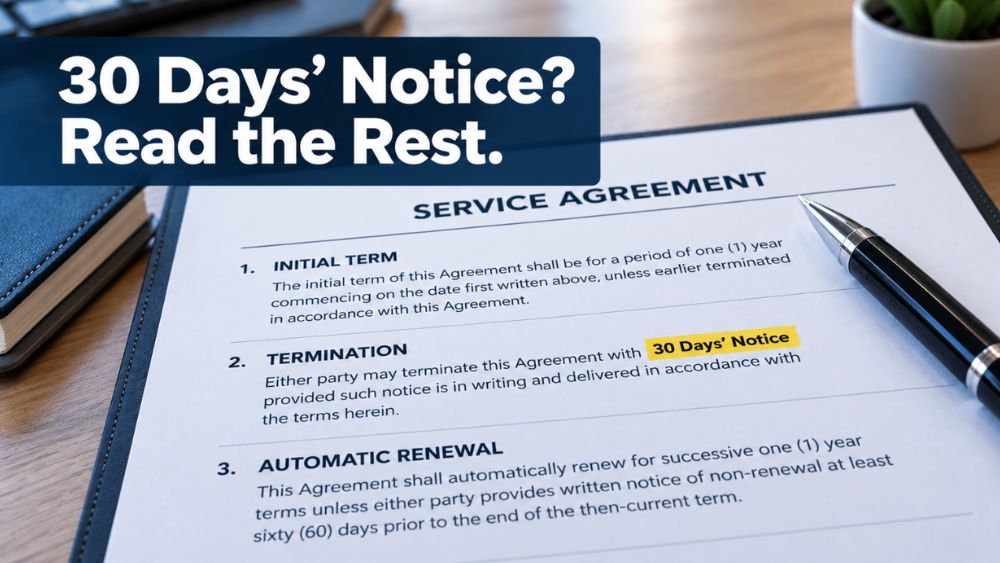
One of the most common sources of confusion is language that appears clear at first. A property manager sees “30 days’ written notice” and assumes the agreement can be ended at any time by providing 30 days’ notice. Elsewhere in the same contract, however, there may be language establishing a one-year initial term or an automatic annual renewal.
That can create two very different interpretations. The property manager believes that giving 30 days’ notice is enough to end the relationship, while the vendor believes the notice only applies at the end of the annual term. Neither side wants to be sorting out that disagreement after the relationship has already become strained.
When reviewing a janitorial contract, do not stop when you find a notice period. Read the entire termination section and look at how it works with the initial term and renewal provisions. If the agreement says it is for one year, ask whether that means you are committed for the entire year or whether either party can terminate early without cause. If the contract mentions 30 days’ notice, determine whether that right applies throughout the agreement or only before the next renewal date.
If the answer is not obvious from the contract itself, that is something worth resolving before anyone signs.
Automatic Renewal Can Create Unexpected Commitments
Automatic renewal clauses are common in janitorial, concierge, landscaping, maintenance and other recurring property service agreements. There is nothing unusual about a contract renewing automatically, but the details matter because some renewal provisions require notice well before the actual expiration date.
For example, an agreement might renew for another year unless written notice is provided 60 days before the anniversary date. If that deadline passes unnoticed, the property may discover that the vendor considers the agreement renewed for another full term. That can be an unpleasant surprise if management had been planning to rebid the work, change companies or make adjustments to the service.
Before signing, make sure you understand three things: when the contract renews, how long the new term lasts and how much notice is required if you do not want it to renew. It is also a good idea to put the renewal date and notice deadline somewhere your management team will actually see them rather than relying on someone to remember the details a year later.
Understand What Happens If You Want to Leave Early
Property managers should also know what happens if they decide to terminate service before the end of the stated contract term. Some agreements allow either party to terminate without cause with proper notice. Others permit early termination but charge a fee, require payment of a portion of the remaining contract value or restrict termination altogether during the initial term.
There is not one contract structure that every vendor must use, but the arrangement should be clear. If you are signing a twelve-month agreement and the expectation is that the property is committed for the entire twelve months, that should be stated plainly. If the agreement can be cancelled at any time with 30 days’ notice, that should be equally obvious.
This is also where phrases such as “initial term,” “successive one-year terms,” “automatic renewal,” “notice of non-renewal,” “early termination” and “liquidated damages” deserve closer attention. None of those terms is automatically a problem, but together they determine what happens if the property wants to change providers.
Make Sure the Contract Matches What You Were Told
Another problem can arise when the explanation provided during the sales process is simpler than the actual contract language. A property manager may ask whether the agreement can be cancelled with 30 days’ notice and be told, “Yes, absolutely.” If that is the understanding between the parties, the written agreement should reflect it clearly.
A year or two later, the salesperson involved in the original conversation may no longer be with the company, the property may have a new manager and no one may remember the discussion in exactly the same way. At that point, everyone will look back at the signed agreement. If the contract says something different from what you were told, it is better to have that language clarified before signing than to rely on a verbal explanation later.
A useful way to test the contract is to ask a very practical question: “If six months from now we decide to change companies, exactly what do we have to do to end this agreement?” The answer should be relatively simple. You should know who receives notice, whether it must be in writing, how much notice is required, whether you can terminate during the initial term and whether any fees apply.
If the answer requires a complicated explanation of what several different sections of the contract are supposed to mean together, the agreement may need clearer language.
A Good Service Contract Should Support the Relationship
The best vendor relationships are not built on making it difficult for a client to leave. They are built on consistent service, responsiveness, communication and the value the vendor provides to the property. A clear cancellation clause supports that relationship because both sides understand their responsibilities from the beginning.
Before signing your next janitorial or recurring property service agreement, spend a few extra minutes reviewing the termination and renewal sections together. Make sure the contract clearly explains what happens if you want to leave, when notice must be provided and whether there are any financial consequences for terminating early.
If the language is confusing, ask the vendor to explain it and make sure the written agreement matches that explanation. Those few minutes of review before signing can prevent a much more difficult conversation later.
Clean Advantage Corporation believes service agreements should be clear, expectations should be transparent and clients should understand exactly what they are signing.