Beyond the Price: 8 Things to Compare on Cleaning Contracts
When reviewing commercial cleaning proposals, it’s easy to focus on one number: the monthly price.
But experienced property managers know that the lowest bid doesn’t always deliver the best value. The real difference between cleaning companies is often found in the details of the contract.
A well-written commercial cleaning contract clearly defines expectations, services, accountability, and communication. A vague agreement can leave room for misunderstandings, inconsistent service, and unexpected costs down the road.
Before making your next decision, here are the areas every property manager should compare.
Start with the Scope of Work
The scope of work is the foundation of your cleaning contract.
Rather than simply promising “general cleaning,” a quality agreement should specify exactly what services will be performed, how often they will be completed, and who is responsible for each task.
Whether your property needs daily janitorial services, day porter coverage, floor maintenance, carpet cleaning, pressure washing, window cleaning, or specialty services, those expectations should be clearly documented from the start.
The more detailed the contract, the fewer surprises you’ll encounter later.
Compare More Than the Monthly Price
Price matters, but value matters more.
Some proposals include routine inspections, quality assurance, floor care, and responsive account management. Others may charge additional fees for services you assumed were already covered.
Instead of asking which company is the least expensive, ask which company provides the most complete solution for your property.
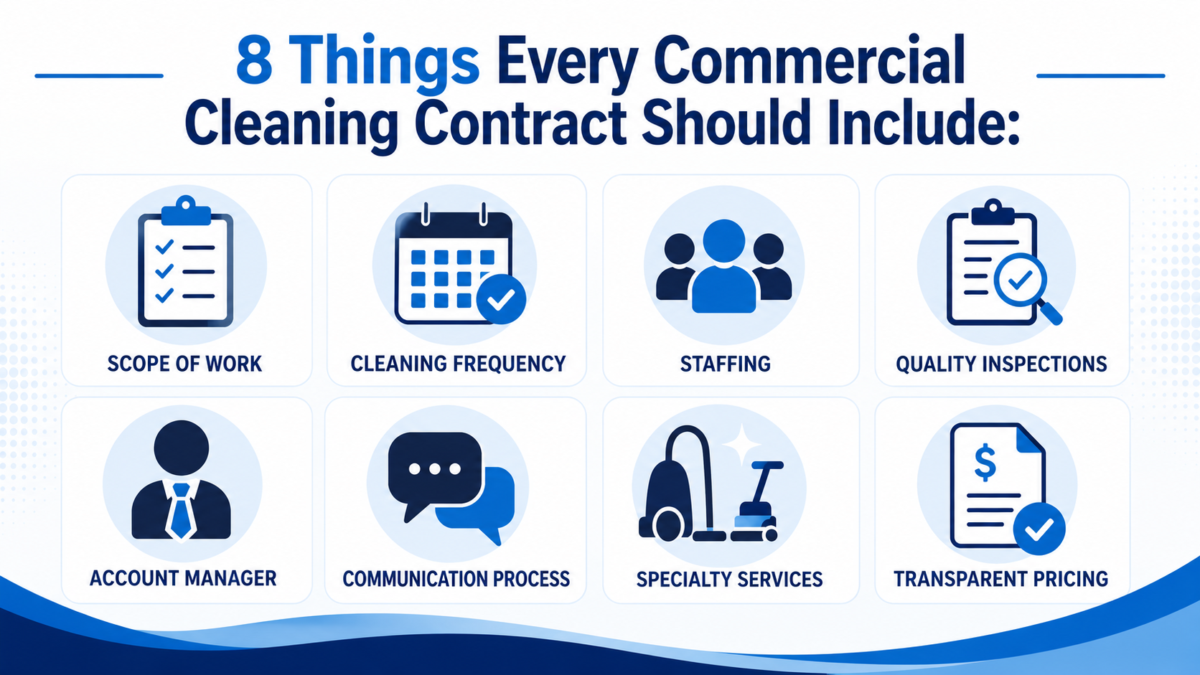
| Contract Feature | Some Cleaning Contracts | Clean Advantage Contracts |
|---|---|---|
| Detailed Scope of Work | May be general or limited | Clearly defines every service provided |
| Service Frequency | May be vague | Documented cleaning schedules |
| Day Porter Services | Often optional or extra | Included when part of your customized plan |
| Floor & Carpet Maintenance | Frequently billed separately | Clearly identified in the agreement |
| Specialty Services | May require additional quotes | Outlined upfront when applicable |
| Quality Inspections | Not always defined | Regular quality assurance process |
| Dedicated Account Manager | May not be specified | Single point of contact |
| Communication Process | Reactive | Clear reporting and responsive communication |
| Transparent Pricing | Possible additional charges | Clearly documented expectations and pricing |
Accountability Creates Better Results
A cleaning contract should explain more than what gets cleaned.
It should also describe how performance is measured, how concerns are addressed, and who is responsible for ongoing communication.
The strongest partnerships are built on regular inspections, proactive communication, and clearly defined expectations that keep everyone aligned.
When accountability is written into the agreement, better service naturally follows.
Choose a Cleaning Partner, Not Just a Cleaning Company
Commercial cleaning affects every tenant, employee, visitor, and prospective client who walks through your doors.
Choosing the right provider isn’t simply about finding the lowest proposal. It’s about selecting a partner who understands your property, communicates consistently, and provides complete transparency from the very beginning.
Before signing your next commercial cleaning agreement, compare more than the monthly price.
Compare the contract.
You may discover that the best value isn’t the lowest number. It’s the company that clearly shows you exactly what you’re getting.